
How to Setup and Zero a scope instructions

ZEROING A SCOPE – SETTING UP YOUR SCOPE
Availability: In stock
SKU: Zero-a-scope-instructions
0.00 incl tax

Instructions on how to Zero a Telescopic Sight o n a Rifle or Pistol.

Setup your sights to you rifles &  pistols.

SOLWARE LTD “A ROUGH GUIDE”

ZEROING A SCOPE – SETTING UP YOUR SCOPE

Before starting, it's important to have the basics right, that is to say the 'eye relief' is properly set (this means that when you shoulder the rifle and look through the scope, you see the full image without moving your head backwards or forwards). - if this needs adjusting, undo the allen bolts slightly and slide the scope along the rail until it's comfortable, then re-tighten. Better to zero your scope when its not windy.

Next, be sure that the crosshairs on the reticle are properly aligned vertically and horizontally, in this picture, I have used the fence panels as a vertical reference. You can use anything that is straight as a guide reference a door or even a plumb line hanging down or fencing post (Just make sure it is straight!)

If this needs correcting, slacken off the Allen bolts on top of the mounts, and gently rotate the scope (without moving it back and forth), and then re-tighten.

Your reticle may not look like the one in the picture, it may look like one of these -

or even another style, either way it will generally have horizontal and vertical references.

Now we are ready for business. Try to do this on a day with no crosswind! Even better indoors.

On the top and side of the scope, around half way along, you'll find the 'turrets', that is to say the dials that you'll use to zero, which are often referred to as 'windage' and 'elevation'. Sometimes these are already exposed, often, they're under caps like this - 
If caps are fitted, take them off and put them to one side.

Next, find a cardboard box perhaps a foot square on the face, fill it with something heavy and make a cross (+ not x) about 2" high and 2" wide in the middle of the box with a marker pen, measure or pace it out and place it so that it's 10 yards away, then make sure of your backstop. You can also use paper targets as a zeroing guide.

With the rifle on a firm support / on a bipod / as stable as you can make it, and using your favoured pellets, take three careful shots at the centre of the cross. If shooting a spring gun please use a shooting bag or cushion to lean on. Do not use hard surfaces as this will effect the recoil which is part of mechanism of a spring gun it needs to recoil to shoot. If all is well, you'll have a tight group of shots. For this example, let's say you're 1" low and 1" right of centre. Please note that when zeroing your scope you are doing so using a particular brand of pellets. You may have to re-zero if you change to a different pellet. Also if you upgrade and get a silencer you will need to rezero again

Always adjust for vertical first, as barring crosswinds your vertical alignment won't change with distance, and using the turret on the side of the scope, you'll see something similar to this -

This type adjusts with your fingers, some use a screwdriver, and in yet others the whole barrel turns, but it should be fairly obvious.

You'll notice a marking 'L', meaning left, and an arrow indicating which way to go. You'll also notice the markings example '1 click ¼" 100 yards', meaning that each click in the direction of the arrow will shift your effective point of impact ¼" left at a range of 100 yards. Since we are working at only one tenth of that distance, each click will only shift aim by one tenth of the amount, so in our example 40 clicks will be needed to get to the vertical line at 10 yards.

Take another shot at centre, and see where you are, repeating as necessary until you are striking the vertical line, and of course to shift the effective point of aim to the right, turn the turret dial in the opposite direction, ie. against the arrow.

When you are hitting the vertical line (in our example, we'll be 1" below the horizontal line), you can move on to the elevation turret -

and the idea is much the same, except that the dial is marked 'UP'. In our example, roughly 40 clicks will be needed to get up the horizontal. Again, repeat as necessary and fine tune.

Once you are happy, move the target out to your chosen zeroing distance, (in my case 30 yards), and fine tune using the same procedure laid out. Bear in mind that at 30 yards, approximately one third of the number of clicks will be needed, ie roughly 12 clicks to shift by an inch. (since 30 yards is nearly one third of the 100 yards that the turrets are calibrated for). Replace your turret caps if fitted, job's a goodun.

REMEMBER WHEN YOU CHANGE YOUR PELLETS

YOU NEED TO REZERO YOUR SCOPE 

YOU ALSO NEED TO REZERO IF YOU ADD A SILENCER

Zeroing Distances (If you have the Distance to Shoot)

.177 – ZERO AT APPROX 30-35 YARDS

.22 – ZERO AT APPROX 25-30 YARDS

Only registered users can write reviews

Related Products
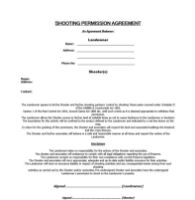
Shooting Permission

Perms form, letter of permission to shoot on landowners property. This is a basic letter that you can simply print and then complete and then get teh landowner to simply sign. This will then be a valid document to prrove to the police you have authorisation to shoot on the lands to then obtain a licence.
0.00 incl tax