
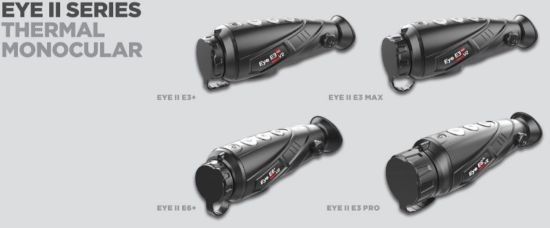
Unlike traditional optics, thermal devices do not depend on visible light. Instead, they detect differences in heat, allowing the user to identify animals, people and other heat sources in darkness and difficult viewing conditions.
The range of thermal products available has grown considerably, with compact entry-level models sitting alongside advanced devices featuring high-resolution sensors, laser rangefinders and recording functions.
Choosing the right thermal monocular is therefore not simply a case of buying the most expensive model. The best choice depends on how, where and how often the device will be used.
Start with the Thermal Sensor
The sensor is one of the most important parts of any thermal monocular.
Its resolution affects the amount of detail shown in the thermal image. A higher-resolution sensor will generally provide a clearer picture and make it easier to distinguish between objects, particularly over longer distances.
Entry-level models can still be highly effective for general observation, locating heat sources and shorter-range use. More advanced sensors become increasingly valuable where the user needs improved detail, identification or performance at greater distances.
It is also worth looking at thermal sensitivity, which is often expressed as NETD. A lower NETD figure generally means the device can recognise smaller differences in temperature, producing better detail when the background and subject are similar in temperature.
Consider the Lens and Detection Range
The lens size affects the field of view, magnification and practical detection distance.
A smaller lens normally provides a wider field of view, which can be helpful when scanning woodland, fields or areas at closer range. Larger lenses tend to provide greater base magnification and improved long-range observation, although the field of view may become narrower.
The advertised detection range can provide a useful comparison, but it should not be confused with identification range. A device may detect that a heat source is present at a considerable distance without showing enough detail to identify exactly what it is.
Think realistically about the distances at which the monocular will normally be used rather than simply choosing the highest figure on the specification sheet.
Image Quality Is More Than Resolution
Sensor resolution matters, but it is not the only factor affecting image quality.
The display, software processing, refresh rate and available colour palettes all contribute to the viewing experience. Some users prefer the strong contrast of white-hot or black-hot modes, while others find alternative palettes useful when observing for longer periods.
Digital zoom can help examine part of the image more closely, although increasing digital magnification will usually reduce visible detail. A good-quality base image is therefore more important than a very high digital zoom figure.
Some advanced thermal monoculars combine thermal and conventional optical channels. Fusion modes can use visible-light detail to improve the definition of the thermal image, making surroundings and subjects easier to interpret.
Battery Life and Practical Design
A thermal monocular needs to be comfortable and practical in real-world conditions.
Check whether the model uses removable or built-in batteries, how long it is expected to operate and whether spare power options are readily available. Cold conditions, recording and intensive use of features may reduce practical battery life.
Weight, button layout and overall size should also be considered. A compact monocular may be easier to carry for long periods, while a larger unit may offer a bigger battery, improved controls or more advanced features.
Weather resistance is another useful consideration for outdoor use. A robust housing and suitable protection against rain, dust and knocks can make a meaningful difference over time.
Useful Additional Features
Modern thermal monoculars may include:
- onboard photo and video recording;
- Wi-Fi or app connectivity;
- picture-in-picture viewing;
- multiple zero or observation profiles;
- built-in laser rangefinders;
- interchangeable batteries; and
- optical and thermal fusion modes.
These features can be extremely useful, but they also affect the price. Buyers should prioritise the functions they will genuinely use rather than paying for technology that may remain untouched.
Choosing the Right Thermal Monocular
The best thermal monocular is the one that suits the intended environment, viewing distance and budget.
Solware stocks thermal monoculars and related optics from established manufacturers including HIKMICRO, Guide Outdoor, Infiray and ATN. The range includes compact models for general observation through to advanced thermal and optical systems with laser rangefinding and recording features.
For advice on choosing a thermal monocular, visit https://www.solware.co.uk/ or explore the thermal vision range online.
You can also call the Solware team on 01827 215222 or email [email protected] for product availability and practical advice.