From wildlife observation and countryside monitoring to property inspections and search-and-rescue activities, thermal technology has become increasingly accessible.
Manufacturers such as HIKMICRO neos thermal air rifle scopes have helped bring sophisticated infrared sensors, digital displays and portable imaging systems into modern outdoor equipment.
But what do specifications such as thermal resolution, NETD, detection range and refresh rate actually mean?
Understanding these terms can help explain how thermal imaging works and why different devices produce different results.
How Does Thermal Imaging Work?
Unlike a traditional camera, which records visible light, a thermal imaging device detects infrared radiation emitted by objects.
All objects above absolute zero emit infrared radiation, although the amount detected varies according to temperature, surface characteristics and environmental conditions.
A thermal sensor converts this radiation into electronic signals, which are processed into a visible image.
Depending on the selected display mode, warmer and cooler areas appear in different shades or colours.
This allows the observer to distinguish temperature differences even when ordinary lighting is extremely limited.
However, thermal imaging is not the same as being able to see through solid objects. Walls, ordinary glass and many other materials block the infrared radiation used by these devices.
Understanding Thermal Sensor Resolution
Sensor resolution is one of the most frequently discussed specifications.
It describes the number of individual detecting elements within the thermal sensor.
For example, a resolution of 640 × 512 represents 327,680 detecting elements.
Higher-resolution sensors can capture more detail, although image quality also depends on the lens, thermal sensitivity and software processing.
The resolution of the viewing screen is a separate specification and should not be confused with the resolution of the thermal sensor itself.
What Does NETD Mean?
NETD stands for Noise Equivalent Temperature Difference.
It describes a thermal sensor's ability to distinguish small temperature differences.
Measured in millikelvin (mK), lower NETD figures generally indicate greater thermal sensitivity under comparable testing conditions.
This can influence the amount of visible detail in scenes where objects have relatively similar temperatures.
However, the overall results depend on more than one specification.
Lens performance, image processing, atmospheric conditions and sensor calibration all contribute to the final picture.
Thermal Monoculars and Other Optical Systems
Thermal imaging equipment is available in several configurations.
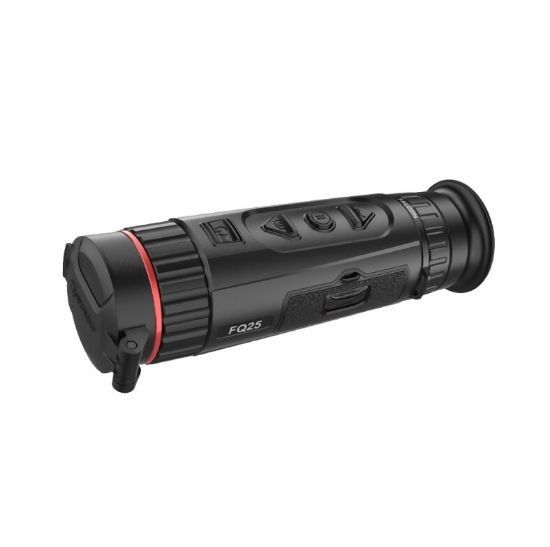
A hikmicro falcon thermal monocular is designed for observation through a single eyepiece, making it useful for activities such as wildlife monitoring and outdoor surveying.
Mounted thermal systems have different physical arrangements and operating requirements.
The HIKMICRO Falcon FQ35 Pro is an example of a handheld observation monocular. Its published specifications include a 640 × 512 thermal sensor, 35 mm lens and NETD below 20 mK.
These figures illustrate how sensor resolution, optical design and sensitivity combine within a portable thermal imaging system.
What Is Thermal Detection Range?
Manufacturers commonly publish a maximum detection range for their thermal equipment.
This indicates the approximate distance at which a specified heat source may be detected under particular conditions.
Importantly, detecting a thermal signature is not the same as recognising or positively identifying what produced it.
Weather, object size, temperature contrast and environmental conditions can all affect practical visibility.
Published detection figures should therefore be understood as performance specifications rather than guarantees of image detail at a particular distance.
Battery Life and Outdoor Performance
Portable thermal devices rely on rechargeable batteries, making operating time an important practical consideration.
Battery performance varies with ambient temperature, display settings, recording functions and wireless connectivity.
Some devices incorporate replaceable batteries, allowing the manufacturer to offer different power-management arrangements.
Thermal equipment may also provide image-calibration functions to maintain consistency during operation.
Users should follow the manufacturer's instructions for charging, storage and routine care.
Understanding the Benefits and Limitations
Thermal imaging is particularly useful for observing temperature contrasts in darkness and challenging lighting conditions.
Nevertheless, fog, heavy rain, atmospheric moisture and reflective surfaces can all influence the resulting image.
Understanding these limitations is important when interpreting thermal information.
As the technology continues to develop, improvements in sensors and image processing are likely to remain important areas of innovation.
For anyone researching thermal imaging, learning how the specifications relate to real-world performance is a useful starting point.
Frequently Asked Questions
1. What is the difference between thermal imaging and traditional night vision?
Thermal imaging detects infrared radiation emitted by objects and converts temperature differences into a visible image. Traditional night vision generally works by amplifying available light, while some digital systems use infrared illumination. Thermal cameras can therefore operate without visible light, although environmental conditions still affect their performance. Neither technology can see through ordinary solid walls. Understanding these differences helps explain why thermal imaging and night vision produce different pictures in darkness and low-light conditions.
2. What specifications are most important when understanding a thermal monocular?
Important thermal monocular specifications include sensor resolution, NETD thermal sensitivity, lens focal length, field of view, display resolution and battery life. Sensor resolution influences the detail captured, while NETD describes the ability to distinguish small temperature differences. Lens characteristics affect the visible scene, and environmental conditions influence practical performance. No single specification determines overall image quality, so it is important to consider the complete imaging system and manufacturer's published technical information.